
Submission Info
Submitting Your Abstract Online
You must register (and pay) for the symposium in order to present a talk or poster.

The Process
Please read and follow the instructions provided below. You will need to input your contact information, a brief bio, and your abstract. We recommend having this info ready before you start; however, you can always log in to your dashboard later to make changes.
Stipends
We will be offering stipends to help offset the costs of full symposium registrations for AHS student members:
Students: 50% registrations (first-come, first-served) for students who need financial assistance. Preference will to students presenting a talk or poster.
You can download the stipend application here.
Submission Guidelines
The deadline for submitting is March 20th. We encourage you to start this process as soon as possible because talk slots are limited this year.
Evaluators will use the following criteria when deciding whether to accept or reject your abstract:
-
-
- Is the talk off topic, political, or competitor bashing?
- Is the abstract a marketing effort rather than an information exchange through case studies?
- Would our members find this topic interesting or innovative?
- Are you a student? We encourage students to give presentations or posters.
-
We reserve the right to edit for concision and clarity.
For more information, email us at [email protected]
Instructions
Follow these instructions to first create a user account and then to complete the abstract submission form. You must create a brand new account — the login credentials you use on the AHS website will not work here.
-
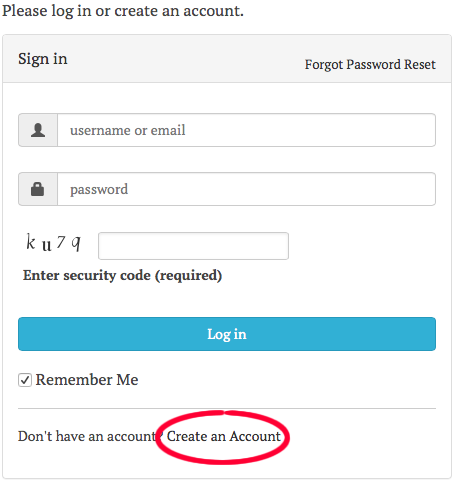
- Create a user account by clicking the Log in or Create an Account button below. A sign-in form should appear.
- Click the Create an Account link.
- In the form that appears next, complete the login and account sections and then click Register. You may receive a confirmation email, but this is not necessary to continue.
- Log in to your account (if necessary) and submit your abstract online.
Potential Topics
We welcome submittals on any topic that may be of interest to the Arizona hydrologic community. We will, however, reject any abstracts that are sales oriented.
Surface Water Management
-
-
- Watershed & basin planning
- Reservoir operations & optimization
-
Flood control & floodplain management
-
Stormwater capture & reuse
-
Mining surface water controls
-
Industrial surface water supply
- Riparian restoration
- Forest management and restoration
-
Water Quality & Geohydrology
-
-
- Hydrostratigraphic characterization
- Groundwater–surface water interaction
- Salinity & TDS
- PFAS & emerging contaminants
- Isotope hydrology
- Source water protection
- Mine-impacted water quality
-
Water Rights & Policy
-
-
-
Interstate compacts
-
Tribal water rights
-
Regulatory permitting
-
Industrial/data center water rights
-
Mining water rights compliance
-
-
Well Operations
-
-
-
Well design & construction
-
Pumping tests & aquifer performance
-
Production optimization
-
Well rehabilitation
-
Monitoring & instrumentation
-
Managed pumping strategies
-
Industrial supply wells
-
Mine dewatering systems
-
-
Colorado River Issues
-
-
- Basin hydrology & modeling
- Shortage & surplus operations
- Drought contingency planning
- System conservation programs
- Lower Basin groundwater reliance
- Interstate negotiations
- Municipal & industrial supply risks
-
Water Resource Management
-
-
- Integrated water management
- Supply–demand balancing
- Conjunctive use strategies
- Drought resilience
- Portfolio diversification
- Industrial water planning
- Data center water demand & cooling
- Mining water supply strategies
-
Groundwater Remediation
-
-
- Site characterization
- Contaminant transport modeling
- Pump-and-treat systems
- In situ remediation
- Monitored natural attenuation
- Vapor intrusion
- Mine-related contamination
-
Water Planning & Sustainability
-
-
- Long-range water plans
- Climate adaptation strategies
- Conservation & efficiency
- Reuse & recycled water
- Water–energy nexus
- Sustainability metrics
- Data center water stewardship
- Mining closure & post-closure water planning
- Subsidence monitoring
-
Tools & Methods
-
-
- MODFLOW / GWT modeling
- Integrated SW–GW models
- GIS & spatial analysis
- Remote sensing
- Data visualization & dashboards
- Monitoring network design
-
Scenario & uncertainty analysis
-
Geochemical modeling
- Well Logging
- Geophysics
-
Aquifer Recharge
-
-
- Managed aquifer recharge (MAR)
- Aquifer storage & recovery (ASR)
- Stormwater infiltration
- Recharge basin design
- Source water quality for recharge
- Recharge permitting
- Industrial recharge projects
- Mine water reuse for recharge
-